
%20(2).jpg)


.png)
Key Takeaways
Returns are now earned at the asset level. Traditional financial levers are contributing less to value creation than they once did. For multi-site operators, the outcome of every investment thesis is now decided one box at a time.
Brand strength no longer offsets weak locations. Fewer than half of tracked restaurant brands are generating positive same-store sales growth, while the bottom quartile is sharply negative. The dispersion between top- and bottom-performing locations, within the same brand or market, has widened meaningfully.
Operator-led, data-driven execution separates outcomes. Sponsors and operators executing with discipline at the unit level are compounding returns and creating meaningful separation from the field.
The Environment Has Reset
Multi-site businesses are operating under a fundamentally different set of conditions than the ones that governed the last decade of expansion. Capital is more expensive, consumers are more selective, and the cost structure has reset higher. What used to be cyclical pressure has become structural, and the math of value creation has shifted accordingly.
Returns are now earned at the asset level, one box at a time.
Several external forces are compounding this pressure:
- Consumer behavior is increasingly localized and value-driven, with both visit frequency and spend varying significantly by market and micro-market.
- Fuel price volatility and shifting mobility patterns are altering trade areas in ways that undermine legacy site selection assumptions.
- According to the National Restaurant Association, occupancy costs have risen 8.3% over the past three years, operating costs 16.7%, and labor costs 18.3%. (1)
- Capital deployment windows have tightened across private markets, placing a premium on operational value creation.
Performance is no longer driven by brand strength alone. It is determined by whether each individual location, the box, can sustain and adapt within its specific market.
Spotlight: Same Brand Equity, Opposite Outcomes
Two casual dining chains operating in the same segment, under similar consumer conditions, have recently produced starkly different results.
Chili's posted approximately +31% same-store sales growth in a single quarter, driven by value-focused marketing and a disciplined, multi-quarter turnaround.5
Applebee's, in the same segment, has reported seven consecutive quarters of same-store sales declines and is closing units and co-branding locations to mitigate underperformance.2
Two brands. Same consumer. Same segment. Opposite outcomes.
The difference is not brand equity. It is execution at the unit level, pricing, traffic, store condition, staffing, and site-by-site performance management. This pattern is now evident across all multi-site categories, from restaurants and fitness to hospitality and retail. Brand strength sets the ceiling. The box determines whether the operator gets there.
Four-bar chart showing top quartile (strong positive growth), second quartile (modestly positive), third quartile (modestly negative), bottom quartile (sharply negative). Fewer than half of tracked brands posted positive same-store sales growth.3
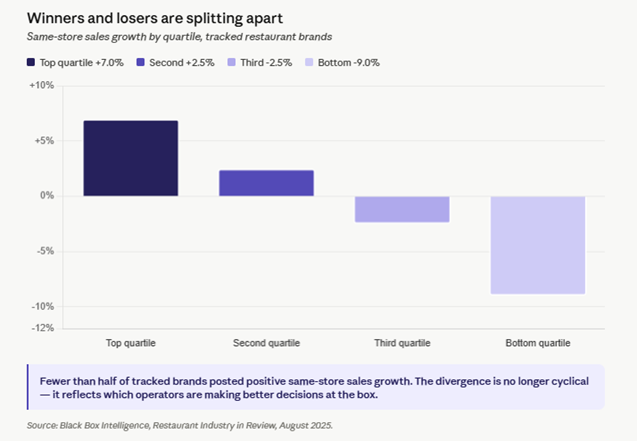
Industry-level same-store sales growth has remained positive in recent months, but fewer than half of tracked brands have participated. The bottom quartile continues to underperform sharply, while top performers gain share.
Divergence is no longer cyclical; it reflects which operators are making better decisions at the box.3
Why the Old Playbook Breaks Down
Most multi-site portfolios were built in a period when speed and scale were rewarded, and expansion decisions were made on broker narratives and static demographic overlays. That approach now produces three consistent patterns:
- Stale underwriting. Historical traffic data reflects past conditions, not current realities. Sites that underwrote well in 2019 may no longer perform under today’s mobility and demand dynamics.
- Fragmented accountability. Real estate, operations, finance, and development often operate independently, each with separate metrics. Locations may appear viable in isolation but underperform at the portfolio level.
- Reactive portfolio management. Underperformance is identified too late, allowing drag to compound before a coordinated response is implemented.
In an environment where every point of EBITDA growth must be earned, these inefficiencies are no longer absorbable.
Getting the Box Right: What Leading Operators Are Doing
Across ZCGC engagements, top-performing operators and sponsors producing consistently demonstrate four core disciplines:
- Behavioral-data-driven site selection.
Leading operators evaluate sites against real-time visit data, true trade area overlap, cannibalization risk, and cross-shopping behavior. Platforms like Placer.ai, SafeGraph, and Unacast have turned weeks of guesswork into hours of evidence. This is the single highest-leverage place where AI is changing multi-site decision-making.4 - Underwriting to unit-level KPIs.
Every new location is evaluated against defined thresholds prior to capital deployment: sales per square foot, four-wall EBITDA, occupancy cost ratio, and break-even traffic. Portfolios that enforce these thresholds upfront carry fewer impaired assets over time. - Leases as strategic instruments.
High-performing operators structure leases with flexibility: termination and kick-out rights tied to performance, rent structures aligned with sales thresholds rather than fixed escalators, and built-in optionality to adjust footprint as conditions evolve. - Active portfolio optimization.
Existing locations are continuously evaluated against performance benchmarks, with capital reallocated toward assets that generate compounding returns. Black Box Intelligence data shows locations retaining the same General Manager for twelve consecutive months deliver approximately two percentage points stronger same-store traffic than those with turnover. Execution discipline compounds, and so does execution drag.5
Looking Ahead to Q3: The ZCGC Perspective
For multi-site operators and their sponsors, real estate is no longer a passive input, it is the operating system that governs capital deployment and return generation.
ZCGC works across the full lifecycle of the box, integrating data-driven site selection, lease structuring, development execution, and portfolio optimization into a single operator-led framework: real estate, operations, talent, and finance decisions made in alignment, by the same team, against the same plan.
The strategy can be sound. The brand can be strong. But in multi-site businesses, the outcomes are determined at the box.
Sources
1 National Restaurant Association, 2025 Restaurant Operations Data Abstract, August 2025.
2 Restaurant Dive, Tracking the Same-Store Sales of 24 Major Restaurant Chains, updated March 10, 2026.
3 Black Box Intelligence, Restaurant Industry in Review: Trends from August 2025, October 2025.
4 Placer.ai, AI in Retail: How AI-Powered Location Intelligence Helps Retailers Understand Consumers, Optimize Stores, and Drive Growth, February 2026.
5 Black Box Intelligence, Restaurant Industry in Review: Trends from September 2025, October 2025.
About
ZCG
ZCG is a leading, privately held global firm comprised of private markets asset management, business consulting services, and technology development and solutions.
ZCG’s investors are some of the largest and most sophisticated global institutional investors including pension funds, endowments, foundations, sovereign wealth funds, central banks, and insurance companies.
For almost 30 years, ZCG Principals have invested tens of billions of dollars of capital. ZCG has a global team comprised of approximately 250 professionals. ZCG is headquartered in New York, with eight affiliated offices, across six countries. For more information on ZCG, please visit www.zcg.com.
You can also learn more about ZCGC, the business consulting services platform of ZCG, at www.zcgc.com, and explore ZCG’s technology affiliate, Haptiq, at www.haptiq.com.
About
ZCGC
ZCG Consulting (“ZCGC”) is the business consulting platform of ZCG and is a results‐oriented management consulting firm for middle market businesses. A reliable resource for private equity firms and their portfolio companies, our professionals offer deep functional expertise and customizable hands-on solutions to accelerate growth.