




Key Takeaways – Exit Backlog, CV, and Buyer Opportunity
PE exit backlog equals nearly 30% of S&P 500 market cap
33,575 unsold companies represent approximately $20.1 trillion in enterprise value—nearly 30% of the S&P 500—underscoring the historic scale of the opportunity.
Aging portfolio company holds and 15-year fund lives are shifting the balance toward capable buyers
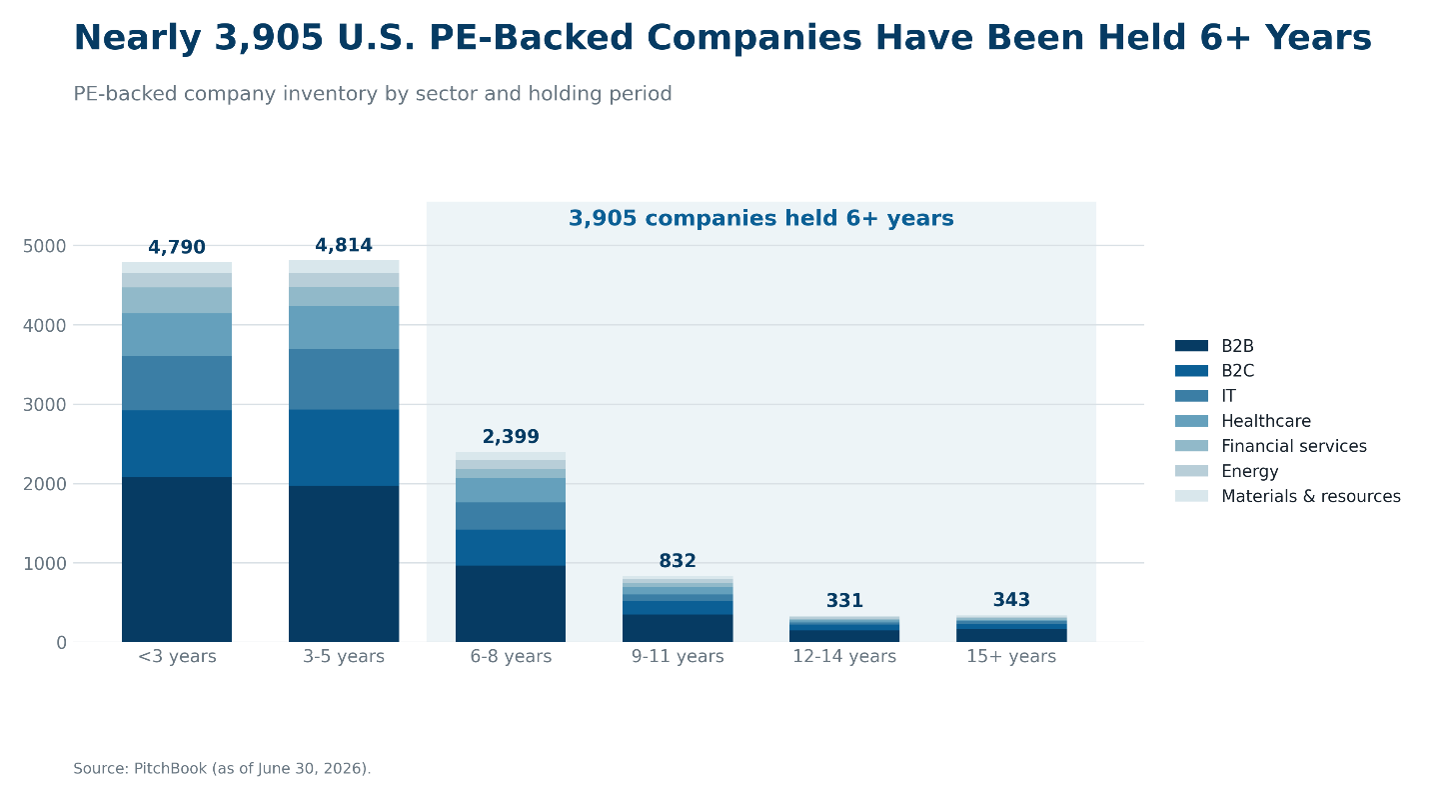
Nearly 3,905 U.S. PE-backed companies have been held for six years or longer, while the median life of a private equity fund has risen to 15 years. As sponsors face pressure to improve DPI, fundamentally sound businesses may become available on more actionable terms.
Dry powder can translate into a higher price—and a decisive edge—vs. secondary buyers or strategies
Continuation vehicles are effective and have commercial value, but are not one-size-fits-all. PE firms with dry powder can apply a fresh analytical framework, underwrite a more creative value-creation plan and, where conviction supports it, pay a higher price.
The 33,575-company global PE exit backlog could represent an historic buying opportunity with up to approximately $20 trillion in enterprise value - nearly 30% of estimated S&P 500 market value. That scale creates a historic opportunity for secondary investors, continuation vehicles and PE firms with dry powder and differentiated conviction.
A Private-Market Universe Approaching 30% of the S&P 500 Market Cap
The private equity exit backlog is typically framed as a liquidity problem. It is one. But viewed from the other side of the transaction, it may also represent one of the largest pools of potential acquisition value in private equity history.
As of June 30, 2026, private equity firms held 33,575 unsold companies globally. Lincoln International tracks approximately 1,800 sponsored middle-market companies with median EBITDA of roughly $50 million to $60 million. Applying an enterprise-value multiple of approximately 11.5x implies an average enterprise value of about $600 million per company.
Figure 1: The Nearly 30% Opportunity
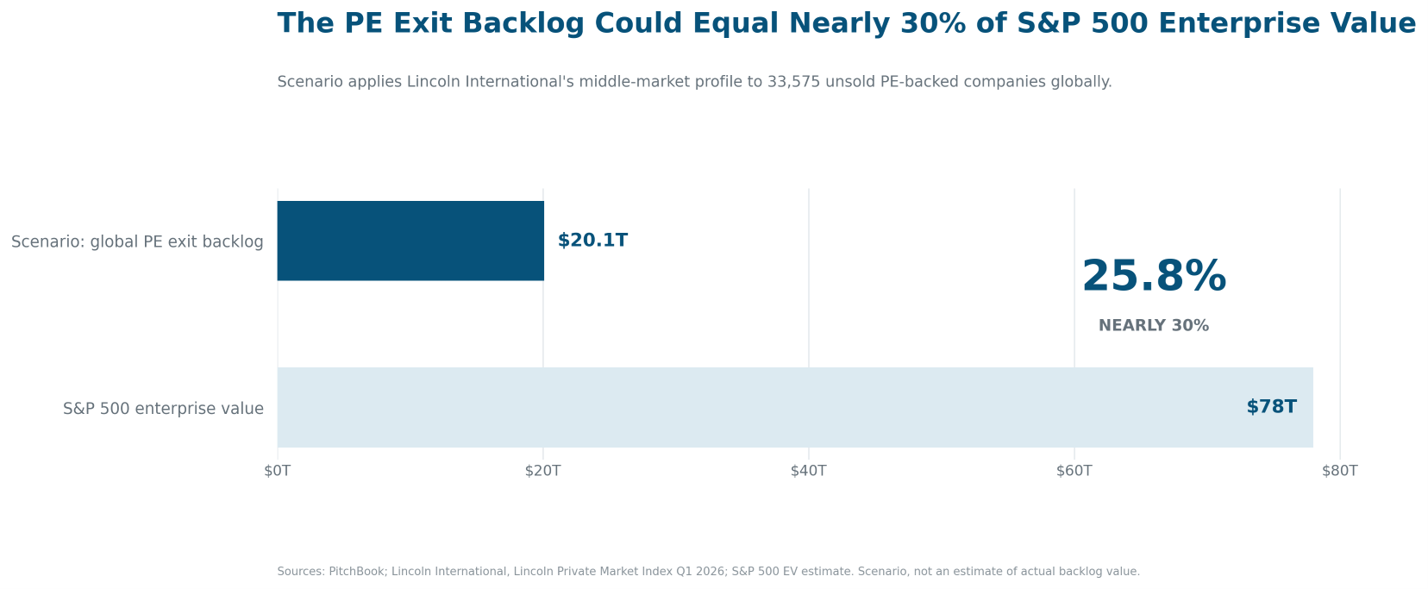
Applying that profile to the global backlog produces an illustrative value of approximately $20.1 trillion, equal to 25.8%, or nearly 30%, of the S&P 500’s estimated $78 trillion enterprise value. This is a scenario, not an estimate of the backlog’s actual value, because Lincoln’s middle-market universe excludes both the largest companies and smaller add-ons. Nevertheless, it demonstrates the extraordinary scale of value potentially sitting within the exit pipeline. A more conservative case, based on Bain’s $3.8 trillion of unrealized equity value and a 50% debt-to-enterprise-value assumption, implies approximately $8 trillion, or 10.2% of S&P 500 enterprise value. Even under that scenario, the opportunity is substantial.
The Backlog Is Becoming a Sourcing Environment
The inventory has accumulated because the traditional private equity loop - acquire, improve, exit and return capital - has slowed due to inflation, changing consumer trends, tariffs, and high capital costs. Valuation gaps remain wide, the IPO market has reopened only selectively, and financing costs remain materially higher than during the zero-rate era. The result is a growing global backlog and longer holding periods. Within the United States alone, the PE-backed inventory reached 13,509 companies at midyear 2026.
Of the U.S. inventory, 3,905 companies, or 29%, have been held for six years or longer.
Figure 2: Age of U.S. PE-Backed Inventory
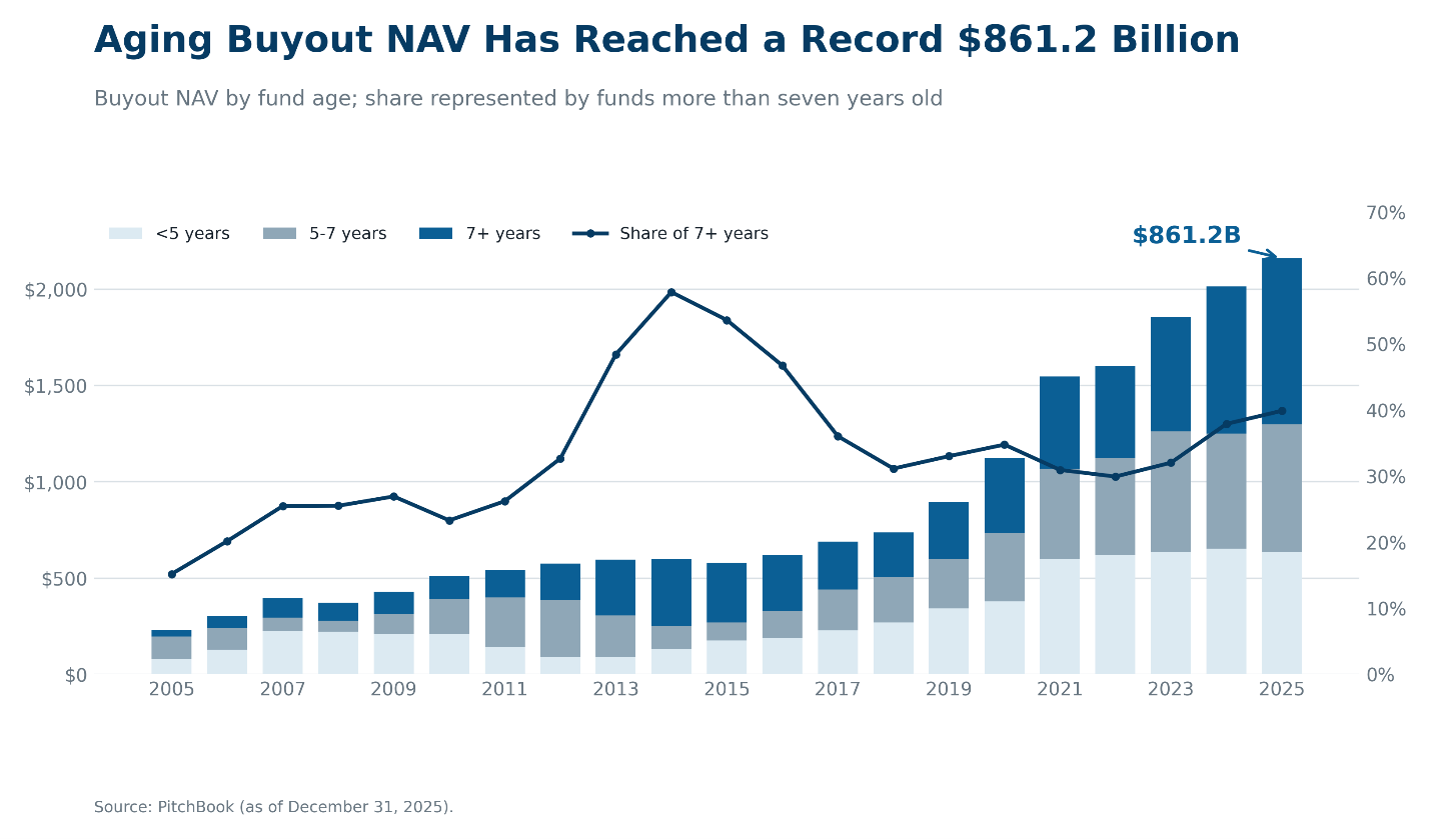
At the fund level, buyout NAV in vehicles more than seven years old reached a record $861.2 billion at year-end 2025, 2.8 times its 2015 level.
Figure 3: Aging Buyout NAV
Those figures matter because time changes the priorities of both sponsors and LPs. The traditional 10-year private equity fund is becoming increasingly uncommon: according to Jefferies, the median life of a private equity fund has risen to 15 years. Kroll data also indicate that returns tend to stagnate after eight years before declining as holding periods extend, while distributions to investors as a percentage of portfolio value are near a 16-year low.The traditional 10-year private equity fund is becoming increasingly uncommon: according to Jefferies, the median life of a private equity fund has risen to 15 years. Kroll data also indicate that returns tend to stagnate after eight years before declining asholding periods extend, while distributions to investors as a percentage of portfolio value are near a 16-year low. As funds age, distributions become more important, fundraising pressure intensifies and the value of a clean, executable exit rises.
That does not mean the entire backlog is distressed or immediately available. Some companies are high-quality assets whose owners are deliberately waiting for a better exit window. Others may need more capital, a refreshed strategy or more focused operational attention. The opportunity lies in distinguishing between businesses that are impaired and businesses whose ownership structure or hold period has simply run its course.
Why Competitive Buyers Can Gain an Edge
Continuation vehicles have become an important release valve for sponsors seeking liquidity while retaining exposure to assets they believe still have upside. In 2025, continuation-fund-related exits reached a record 158 globally. The process can be highly effective: it can generate liquidity for existing LPs, preserve ownership of a favored asset and provide additional time and capital for value creation. But it is not one-size-fits-all. Price discovery, LP elections, conflict management, financing and the need to validate an extended hold can reduce flexibility and narrow the range of possible outcomes. Bain reports that 20% of limited partners are reducing their buyout allocations because of liquidity pressures or concerns about returns.
A PE firm with dry powder can approach the same asset from a different position. It is not bound by the incumbent sponsor's original thesis, ownership history or continuation structure. It can apply a fresh analytical framework, form a different view of risk and upside, and design a more creative plan around management, growth, operations, capital structure and strategic repositioning. Where that differentiated conviction supports greater future value, the buyer may be able to offer a higher price while also delivering immediate liquidity, transaction certainty and a clean ownership transition.
Figure 4: Buyer Path to Liquidity
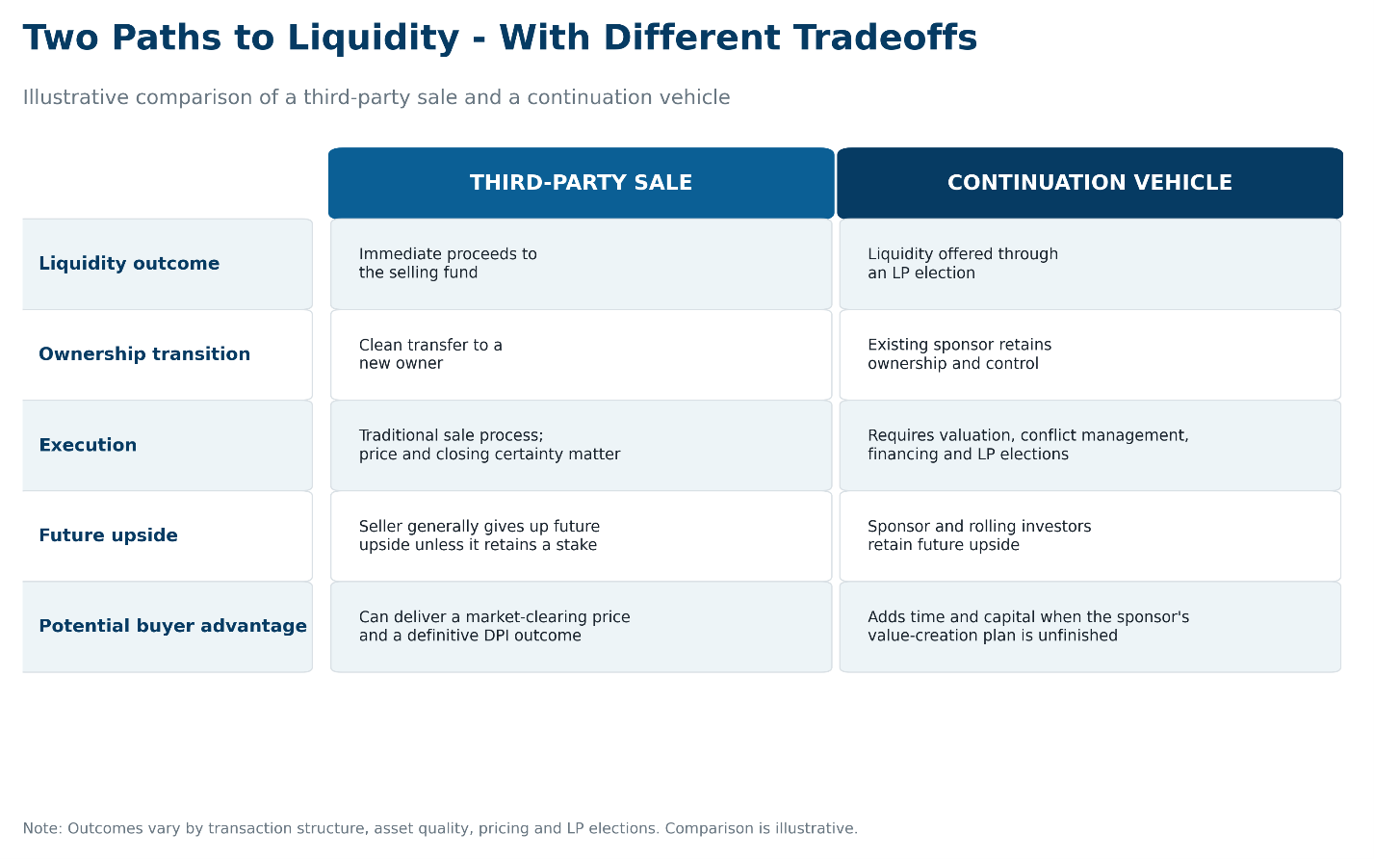
This is where the scale of existing PE backlog becomes strategically important. Secondary funds and continuation-vehicle investors can pursue assets where additional time and capital are the clearest solution. PE firms with dry powder can pursue a broader set of situations, especially where a fresh perspective, flexible structuring or a more ambitious operating plan supports a higher valuation. Buyers do not need to treat the backlog as a single trade. They can target sectors where they have pattern recognition, identify durable businesses and concentrate capital where their distinct view of possibility and value creation gives them an edge.
The Best Assets Will Still Be Competitive
A backlog approaching 30% of the S&P 500's enterprise value does not automatically translate into bargain pricing. High-quality businesses will continue to attract multiple bidders, and sponsors will resist crystallizing losses where they believe additional time can restore value. But this is precisely why dry powder matters. A well-capitalized PE buyer that sees more value – or sees a different path to creating it – may be able to compete at a higher price than buyers operating within a narrower framework. The opportunity is not a broad distressed sweep; it is a large, competitive and highly nuanced buyer's market.
Winning buyers are likely to share four characteristics:
- Sector conviction: A clear view of which revenue streams, customer relationships and competitive advantages can endure through the next ownership cycle.
- Price discipline: The ability to separate a compelling company from an attractive investment and to underwrite returns without relying on multiple expansion.
- Speed and certainty: Flexible capital, focused diligence and the capacity to close when a seller's need for liquidity becomes actionable.
- Transformation capability: Operating resources that can accelerate growth, strengthen management, improve execution and fund the next phase of value creation.
From Exit Problem to Acquisition Opportunity
The defining feature of today's private equity market is not simply that exits are delayed. It is that 33,575 companies now sit inside a global exit backlog that, under a reasonable middle-market scenario, could represent up to approximately 30% of the S&P 500's total enterprise value. Few periods in private equity history have presented buyers with an opportunity set of comparable breadth, scale and strategic variety.
Continuation vehicles will remain an important part of the solution, particularly when incumbent owners have strong conviction in the next phase of an asset's growth. But they are one path – not the only answer for every company. For PE firms with dry powder, the backlog creates an opportunity to bring independent judgment, flexible capital and a new value-creation framework to assets whose current ownership cycle may have run its course.
That difference in perspective can translate into a higher price for sellers and a stronger path forward for the company. In this market, dry powder is more than available capital: paired with conviction, creativity and execution capability, it can win the day.
Sources
Bain & Company. Global Private Equity Report 2026. 2026.
Campbell Lutyens. FY2025 Secondaries Market Overview. February 2026.
Farrell, Maureen. “Private Equity Is Stuck With 33,575 Unsold Businesses.” The New York Times. August 10, 2026.
Lincoln International. Lincoln Private Market Index: Q1 2026. 2026.
Odeh, Layan, Preeti Singh and Laura Benitez. “Private Equity’s 10-Year Fund Vanishes as Firms Cling to Assets.” Bloomberg News. September 22, 2026.
PitchBook. Q2 2026 U.S. PE Breakdown. 2026.
Slickcharts. “S&P 500 Market Capitalization.” Accessed August 2026.
Bloomberg, “Private Equity’s 10-Year Fund Vanishes as Firms Cling to Assets,” September 22, 2026.
About
ZCG
ZCG is a leading, privately held global firm comprised of private markets asset management, business consulting services, and technology development and solutions.
ZCG’s investors are some of the largest and most sophisticated global institutional investors including pension funds, endowments, foundations, sovereign wealth funds, central banks, and insurance companies.
For almost 30 years, ZCG Principals have invested tens of billions of dollars of capital. ZCG has a global team comprised of approximately 250 professionals. ZCG is headquartered in New York, with eight affiliated offices, across six countries. For more information on ZCG, please visit www.zcg.com.
You can also learn more about ZCGC, the business consulting services platform of ZCG, at www.zcgc.com, and explore ZCG’s technology affiliate, Haptiq, at www.haptiq.com.