
%20(2).jpg)

.png)


Key Takeaways – Cost overruns are visible, painful, and negotiated. Delay is quiet, cumulative, and absorbed
Construction budgets still price the wrong risk.
Owners scrutinize construction costs but often overlook the cost of time. Financing carry and delayed cash flow compound every month a project remains under construction, making a six-month delay more expensive than a full year of construction cost inflation.
Time has become a competitive advantage.
Across more than 300 projects exceeding $1 billion in contract value, average cost overruns approached 80% while schedule delays reached nearly 50%.2 Assuming the schedule will hold isn’t a plan – it’s an investment assumption.
Speed should be underwritten like capital.
Industrialized delivery compresses schedules but requires earlier design freeze and capital deployment. The question isn’t whether speed costs more – it’s whether earlier operations create more than waiting.
Construction has traditionally been measured as a delivery function: on time, on budget, to specification. Today, that framework is no longer sufficient.
Projects are financed with more expensive capital and delivered in increasingly constrained labor markets. Global construction cost inflation is running at approximately 4.5% in 2026, with labor shortages now the primary driver of cost increases and North America carrying the highest regional labor costs.1 Owners have responded predictably by scrutinizing cost. Budgets are examined line by line. Value engineering has become routine.
Yet, the largest driver of project economics goes unpriced.
Construction is no longer simply an execution challenge. In today’s capital environment, it is one of the most consequential investment decisions an owner makes.
Every month of delay compounds across the enterprise:
Interest accrues on drawn capital while no revenue is generated.
- Ramp-up, stabilization, and operational learning all shift to the right.
- Competitors enter the market first.
- Projects timed for a demand window can miss it entirely.
- A delay does not always cost a month. It can cost a season.
Spotlight: Same Asset Class, Opposite Timelines
No sector has priced the value of time more aggressively than data centers, and the lessons extend well beyond that asset class.
Conventional hyperscale development typically follows a three-to-four-year delivery cycle. Against that benchmark, one widely reported project converted a shuttered appliance plant into a fully operational AI data center in approximately 122 days, and later repeated the process at a greater scale.3
The acceleration did not come from simply working faster. It came from restructuring the project upstream: repurposing an existing building rather than constructing a new building, standardizing configurations for repeatability, and generating power on site rather than waiting on utility interconnection, which at that scale ordinarily requires 12 to 18 months of substation and transmission work.4
The lesson is not that speed is free. These approaches have attracted regulatory scrutiny and require meaningful trade-offs. The lesson is that delivery timelines are not fixed constraints handed down by the industry. They are the product of how a project is structured. Where an operating month is valuable enough, owners reorganize the entire delivery strategy to capture it.
Figure 1: The Cost of Delay
Value erosion by months past the planned operating date ($250M project, illustrative).
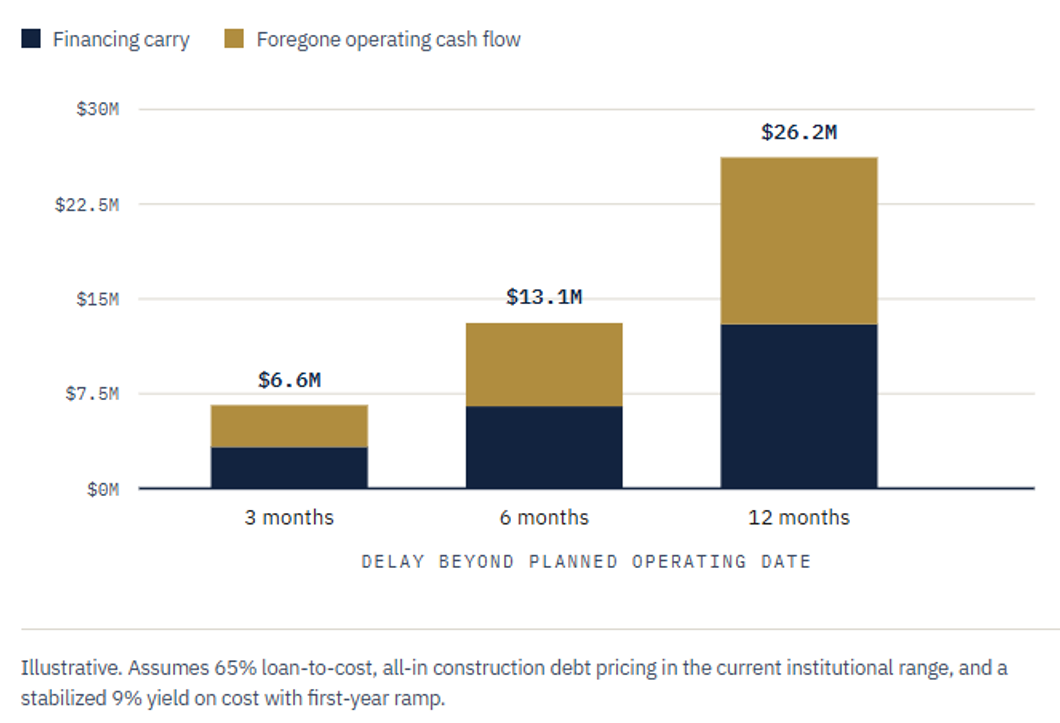
A six-month delay erodes roughly 5% of total project cost, more than a full year of construction cost inflation at current rates. If presented as a cost overrun, it would likely trigger immediate governance action. As a schedule variance, it often does not.
Why the Old Playbook Breaks Down
- Budgets are stress-tested. Schedules are simply reported. They appear in status updates rather than in the underwriting, where they would materially influence investment decisions.
- By the time a delivery method is selected, design is often complete, and many of the decisions that determine the schedule have already been made.
- Development, procurement, construction, and operations are frequently optimized independently, leaving no single owner accountable for the handoffs between them. That is where schedules quietly unravel.
Where the Schedule Is Won: What Leading Owners Are Doing
Sequencing to Dry-In
Once a building is enclosed, interior trades can proceed continuously and in parallel, largely independent of weather and structural sequencing. A week saved reaching dry-in often compounds into several weeks saved during interior fit-out. The structure and envelope therefore deserve the same scrutiny owners apply to construction budgets.
Moving Cure Cycles Off the Critical Path
A cast-in-place post-tensioned concrete frame depends on formwork, concrete placement, and curing, all activities that sit squarely on the critical path. Precast construction shifts much of that work into a manufacturing facility operating in parallel with foundations and site preparation, reducing on-site activities primarily to installation.
Industrializing Repetitive Work
Projects built around repeating units often spend the greatest amount of time in repetitive interior fit-out. Prefabricated bathroom pods, volumetric room assemblies, and multi-trade MEP racks. Modular approaches have consistently demonstrated the ability to reduce project schedules 20% to 50%.5
Figure 2: What the Range Buys
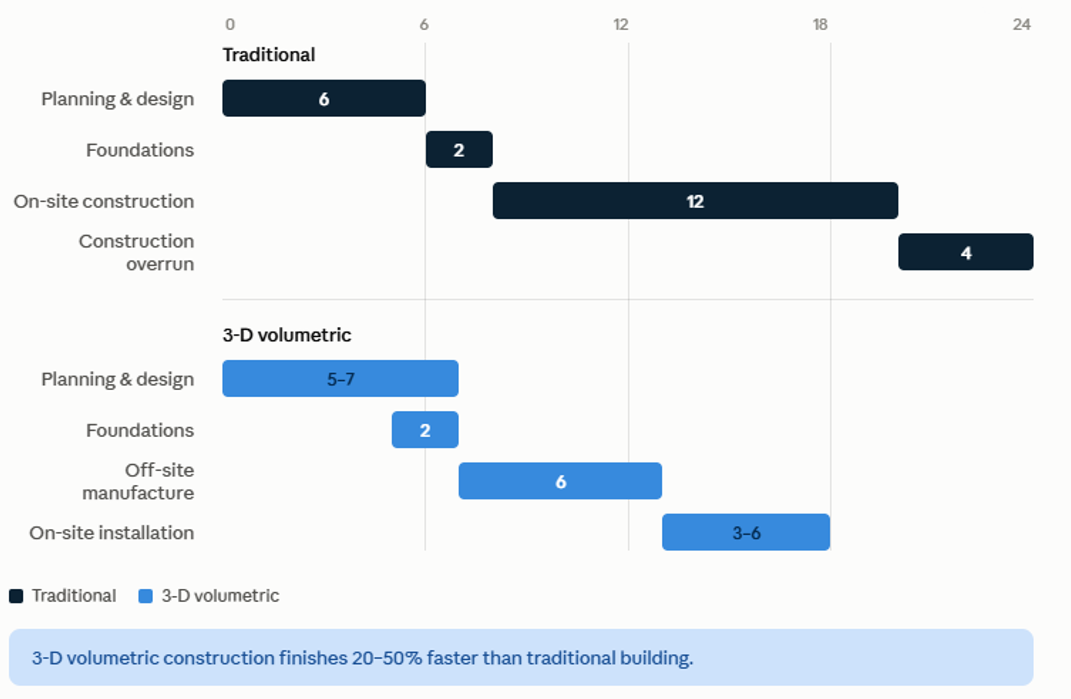
Adoption alone does not prove the magnitude of schedule compression, but it does demonstrate that owners continue underwriting it. Permanent modular construction’s share of North American new construction starts has roughly tripled since 2015, while annual project value has grown from $3.7 billion to $14.6 billion.6 Repeat adoption is the market's own validation of the value proposition.
Pricing the Trade Honestly
Industrialized delivery requires earlier design freeze because fabrication slots, not field sequencing, dictate the schedule. Deposits also accelerate capital deployment.
The question is not whether modular is faster. The question is whether the operating months gained create more value than the opportunity cost of committing capital earlier.
Looking Ahead to Q4: The ZCGC Perspective
Construction can no longer be managed as an isolated delivery function. It must be integrated into the broader value creation strategy from the earliest stages of project planning.
ZCGC aligns development strategy, procurement, delivery methodology, construction management, commissioning, and operational transition into a single execution framework.
That analysis requires both financial and operational expertise.
A finance team working in isolation may not recognize that a curing cycle sits on the critical path. A construction team working independently may not fully quantify the value, or cost, of accelerating design decisions and capital deployment.
The greatest opportunities are created at the intersection of those disciplines.
That intersection is also where projects often lose time, and where owners create lasting competitive advantage.
Sources
1 Turner & Townsend, Global Construction Market Intelligence 2026.
2 McKinsey & Company, Capital Projects & Infrastructure, review of 300+ projects exceeding $1B in contract value.
3 Data Center Frontier and industry reporting on accelerated AI infrastructure delivery, 2026.
4 Industry analysis of utility interconnection timelines for large-loadfacilities, 2026.
5 McKinsey & Company, Modular Construction: From Projects to Products.
6 Modular Building Institute, Permanent Modular Construction Annual Reports, North American market share and project value, 2015 through 2023.
About
ZCG
ZCG is a leading, privately held global firm comprised of private markets asset management, business consulting services, and technology development and solutions.
ZCG’s investors are some of the largest and most sophisticated global institutional investors including pension funds, endowments, foundations, sovereign wealth funds, central banks, and insurance companies.
For almost 30 years, ZCG Principals have invested tens of billions of dollars of capital. ZCG has a global team comprised of approximately 250 professionals. ZCG is headquartered in New York, with eight affiliated offices, across six countries. For more information on ZCG, please visit www.zcg.com.
You can also learn more about ZCGC, the business consulting services platform of ZCG, at www.zcgc.com, and explore ZCG’s technology affiliate, Haptiq, at www.haptiq.com.
About
ZCGC
ZCG Consulting (“ZCGC”) is the business consulting platform of ZCG and is a results‐oriented management consulting firm for middle market businesses. A reliable resource for private equity firms and their portfolio companies, our professionals offer deep functional expertise and customizable hands-on solutions to accelerate growth.