




Key Takeaways – Three priorities for turning AI investment into sustained business value
Data readiness comes first.
Reliable AI depends on connected systems, accurate information, consistent definitions, and clear data ownership.
Business outcomes must drive implementation.
Priority use cases, measurable KPIs, and employee-centered workflows determine whether AI improves daily operations.
Long-term support protects the investment.
Ongoing monitoring, governance, security, upgrades, and employee adoption are essential to sustaining performance after deployment.
Artificial intelligence offers companies significant opportunities to improve decision-making, streamline operations, and strengthen performance. Yet for businesses outside the technology sector, realizing that potential requires far more than adopting new tools. Fragmented data, disconnected systems, limited technical resources, and established operating practices can prevent promising AI initiatives from delivering measurable results. The challenge is not simply implementing technology, but building the capabilities to integrate, manage, and continuously improve it. Increasingly, this requires a technology partnership that extends well beyond initial deployment.
The Transformation Challenge Outside the Technology Sector
For business leaders and operators looking to improve and transform their organizations by leveraging new technology, AI transformation begins with a practical question: Can the business connect the information, people, and processes required to make better decisions and act on them?
The answer depends on considerably more than access to AI technology. It requires reliable data, clearly defined operating processes, specialized implementation expertise, and the ability to maintain and adapt these capabilities as business needs evolve.
Many established businesses possess deep operational knowledge but lack dedicated teams capable of translating that expertise into integrated systems and digital workflows. Internal technology resources are often focused on maintaining existing operations, leaving limited capacity to design, deploy, and support new applications.
Research from leading consulting firms reinforces this challenge. Successful AI adoption requires coordinated progress across data infrastructure, operating processes, employee capabilities, and ongoing governance. Advancing one element without the others can limit the value of the entire investment.
Four capabilities underpin an effective AI technology partnership:
- Reliable Data Foundation: Connected, governed, and traceable information that supports consistent decision-making.
- Operating Discipline: Clear processes, accountability, and decision rights aligned with daily operations.
- Implementation Expertise: Business analysis, data engineering, architecture, and deployment capabilities.
- Continuing Support: Monitoring, maintenance, governance, and upgrades that sustain performance as the business evolves.
Figure 1: The Cost of Delay Figure 1: Barriers to Scaling AI Agents in Deloitte's Surveyed Organizations
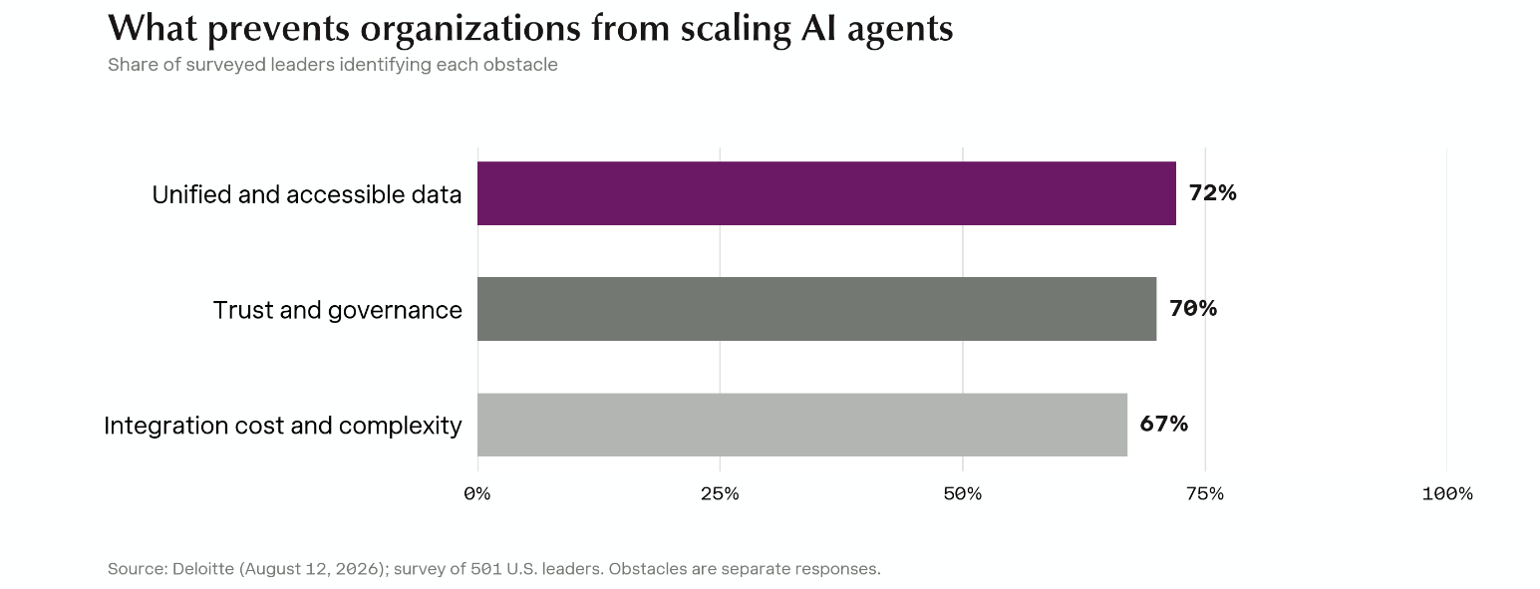
McKinsey's June 2026 research similarly emphasizes the importance of connecting structured business records and unstructured content within a governed, traceable data environment.
However, data readiness should not be treated as an abstract technology objective. It should be evaluated against a specific business application, its operational requirements, and associated risks. Companies can begin with the information necessary to support a priority decision and expand that foundation as additional use cases demonstrate value.
Fragmented Data Makes Business Performance Difficult to See
One of the most persistent barriers to digital transformation is the inability to establish a complete, consistent view of business performance.
Financial information may reside in an enterprise resource planning (ERP) system, customer activity in a customer relationship management (CRM) platform, and production, workforce, or supplier data in separate applications. Contracts, policies, and operational instructions may remain scattered across documents and email. Employees often bridge these gaps through spreadsheets, manual reconciliation, and informal processes.
These workarounds can obscure performance, introduce inconsistencies, and delay decisions.
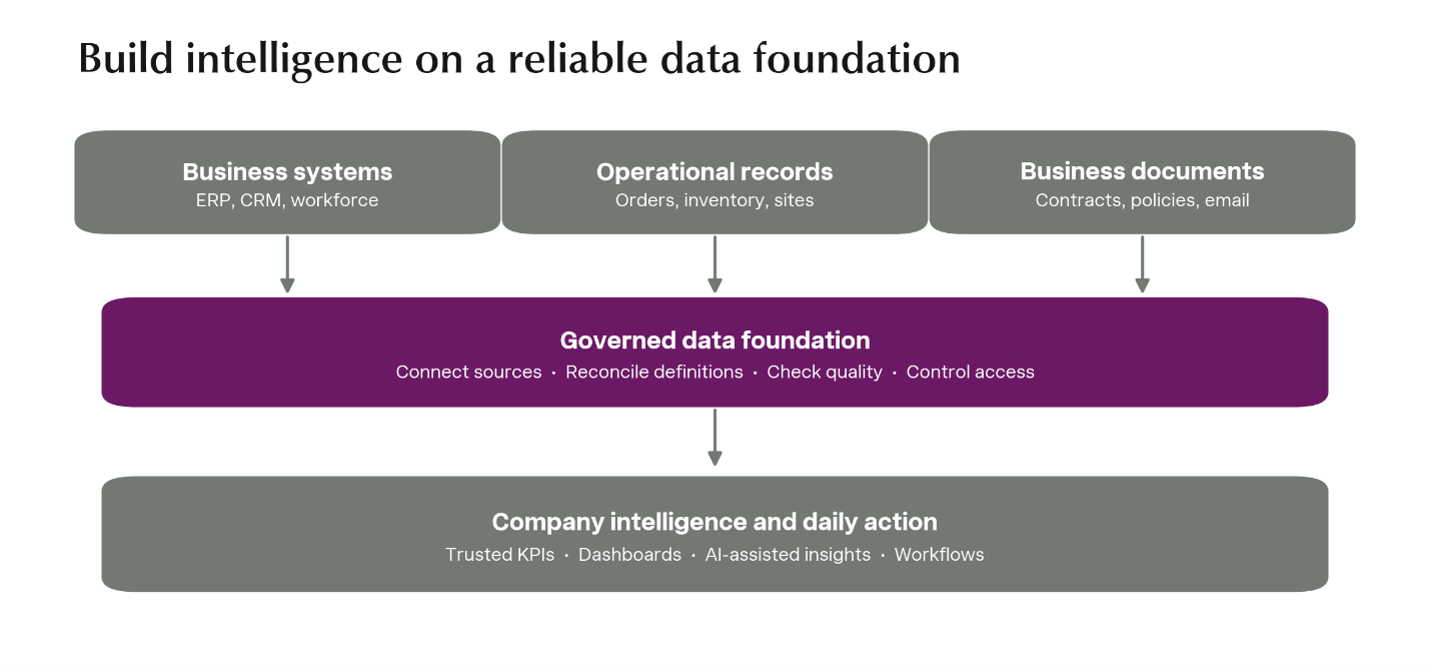
Integrating systems is an important first step, but connectivity alone does not establish a reliable data foundation. Customer and product identifiers must align across applications. Units of measure and reporting periods must be reconciled. Teams must agree on fundamental business definitions, including what constitutes revenue, an on-time delivery, or a completed order.
Equally important, missing information and outdated records require visible quality controls, with clear accountability for resolving discrepancies.
Without this discipline, organizations risk creating more sophisticated reporting and AI applications on top of unreliable information. The result may be faster analysis, but not necessarily better decisions.
Figure 2: Proposed Architecture Connecting Business Data to Daily Decisions
Processes and Reporting Must Translate Information into Action
Access to information creates value only when employees can use it to influence business outcomes.
A consolidated dashboard may improve visibility, but its usefulness depends on whether it supports a specific decision, identifies an actionable exception, or helps an employee respond more effectively.
A plant supervisor and a casino general manager require different operational views from a chief financial officer, even when their decisions rely on the same underlying data. Reporting must therefore reflect the responsibilities, decision rights, and operating cadence of each role.
Effective implementation begins with the workflow itself. What triggers an action? Who reviews an exception? Which approvals are required? How is the decision recorded, and how is the outcome measured?
Established best practices provide a useful foundation, but the final process must reflect the organization's operating realities and the capabilities of its workforce.
Deloitte's 2026 research illustrates the scale of this challenge. In a survey of 501 U.S. leaders, only 5% of respondents considered their business processes highly prepared for AI agents, while 75% believed collaboration between people and AI agents could create greater value than automation alone.
These findings reflect executive assessments rather than demonstrated productivity improvements. Nevertheless, they reinforce an important principle: the role of employees, the structure of workflows, and the responsibilities of a technology partner must be considered alongside the technology itself.
AI should strengthen the organization's ability to execute, rather than introduce another disconnected layer of complexity.
Specialist Talent Connects Business Needs and Technical Delivery
Translating a business objective into a functioning technology solution requires capabilities that extend across multiple disciplines.
Business analysts must understand the organization's operating model, identify process constraints, and translate management priorities into functional requirements. Data engineers connect systems, reconcile information, and establish reliable data pipelines. Solution architects determine how applications, integrations, security controls, and infrastructure work together.
Forward deployment engineers then bridge the gap between design and execution. Working directly with employees, they configure integrations, build tailored tools, resolve implementation issues, and adapt solutions to actual operating conditions.
Few businesses outside the technology sector can justify maintaining all these capabilities internally, particularly when their technology requirements fluctuate across projects.
A long-term technology partner can assemble the necessary expertise around defined priorities while allowing management to retain ownership of business objectives and decisions.
Internal employees remain indispensable. They understand customer expectations, operational exceptions, and the practical constraints that are rarely captured fully in system documentation.
BCG's June 2026 AI at Work study, covering 11,749 workers across 14 markets, similarly emphasizes that organizations must redesign how work is performed to translate individual AI usage into broader business improvement.
The objective is not to replace operational knowledge with technical expertise, but to combine the two in a way that produces measurable results.
Start with a Business Case and Build the Data It Requires
An effective AI engagement should begin with a clearly defined business problem, not a predetermined technology solution.
Management and frontline employees should first identify the outcome they want to improve, the decisions that influence it, and the operational constraints that currently limit performance.
Potential priorities include reducing excess inventory, improving order reliability, accelerating billing, identifying margin leakage, or strengthening workforce planning.
For each use case, the company and its technology partner should establish a baseline, an improvement target, and clear accountability for the result. Performance measures should have agreed definitions, reliable data sources, established review schedules, and corresponding management actions.
Adoption and data quality should be monitored alongside financial and operational outcomes.
Once the business case is established, the technical work can proceed with greater focus.
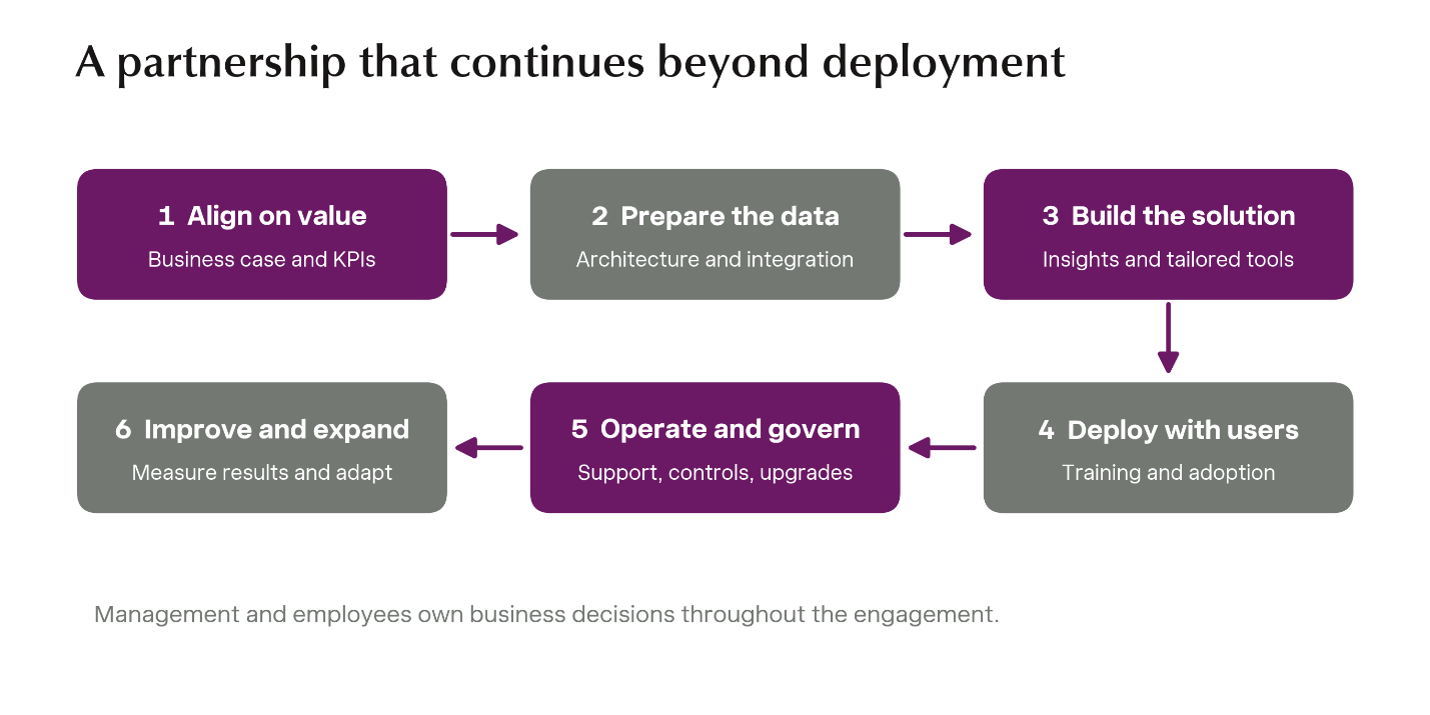
A solution architect defines the integration strategy and security requirements. Data and deployment engineers connect relevant systems, address information-quality issues with business owners, and make validated data available to reporting tools and approved AI applications.
A company intelligence layer can then translate this foundation into usable information through shared metrics, dashboards, and AI-assisted analysis.
Critically, financial and operational calculations should rely on validated business logic. AI can help explain changes, identify patterns, and investigate exceptions, but users must be able to review supporting records and understand the limitations of generated outputs.
Security and access controls must extend beyond source databases to the information retrieved, analyzed, and presented through AI applications.
Implementation should then proceed in manageable increments. Pilot the workflow with intended users, measure results against the baseline, address operational issues, and expand only when the application demonstrates sufficient reliability and value.
Established software should be used where it meets standard requirements. Tailored tools can address the specialized workflows, integrations, and operational requirements that differentiate the business.
This approach limits unnecessary complexity while ensuring that technology investment remains tied to measurable business priorities.
Figure 3: Proposed Delivery and Ongoing Partnership Model
An Illustrative Manufacturing Workflow
The following example is hypothetical and provided for illustrative purposes only. It does not describe any actual ZCGC client or portfolio company, and the results described are not guaranteed.
Consider a manufacturer seeking to reduce late customer orders while limiting excess inventory.
The first step is to connect customer orders, inventory records, production capacity, and supplier lead times. Product identifiers and delivery dates are reconciled, and management establishes consistent performance measures, including delivery reliability, inventory days, and planning cycle time.
With this foundation in place, planners can receive a daily view of orders at risk, the inventory or capacity constraints affecting fulfillment, and the underlying records supporting each assessment.
AI can help summarize likely causes and highlight emerging patterns. A tailored workflow can then direct exceptions to purchasing, production, or other responsible teams for review.
Employees retain authority over operational decisions, approving changes within established processes and controls.
Meanwhile, the technology partner monitors data freshness, system integrations, and application reliability. Management evaluates whether the workflow is delivering measurable improvements against the agreed baseline. The value of the solution lies not in the sophistication of the AI application alone, but in its ability to connect information, analysis, and action within the company's existing operating environment.
Ongoing Operations Protect the Investment
Technology deployment is not the conclusion of an AI transformation. It is the beginning of an ongoing operational responsibility.
Business systems change, integrations fail, data definitions evolve, and new sites or acquisitions introduce additional complexity. Employee responsibilities shift, while AI models and applications require periodic evaluation as software and underlying capabilities are updated.
Without ongoing oversight, even a successful initial implementation can become unreliable or disconnected from the needs of the business.
A sustainable technology partnership must therefore establish clear responsibilities for data monitoring, incident response, access management, recovery procedures, documentation, and system maintenance.
Software and model updates should be tested against representative business tasks before deployment. Operating procedures should also define who has authority to suspend an unreliable workflow, restore a previous version, and communicate changes to affected users. These controls are particularly important as AI applications become more closely integrated with financial reporting, operational planning, and employee decision-making.
Financial commitment must also be understood from the outset. A complete business case should include the continuing costs of integrations, software, AI usage, support, training, security, and upgrades. Regular performance reviews should compare realized outcomes against the original baseline, identify opportunities for improvement, and determine whether applications should be expanded, modified, or retired. Throughout the relationship, the company should retain control of its business definitions, access to its data, and sufficient internal knowledge to direct the partnership effectively.
How ZCGC Partners with Its Portfolio Companies to Bring Business and Technology Together
ZCG Consulting (ZCGC) partners with portfolio companies to connect business strategy with technology execution. Working alongside management teams, ZCGC seeks to improve operating performance, strengthen business processes, establish financial and operational KPIs, and execute transformation initiatives. This approach begins with understanding the business, identifies the information required to manage it, and extends through technology implementation, adoption, and ongoing optimization.
For companies outside the technology sector, the value of a technology partner lies in this continuity: business priorities drive technology decisions, a holistic, collaborative approach keeps implementation close to operational realities, and ongoing support and technical partnerships allow solutions to evolve alongside the organization.
New AI capabilities create opportunities to transform businesses faster than before. They also introduce new risks, and success depends on maintaining a close connection between the people and organizational knowledge of the business and the capabilities of the technology.
The goal is not to replace everyone in the organization and let AI run the business, but to empower people and uncover new business opportunities through a joint understanding of business strategy and technology implementation.
Sources
McKinsey & Company. (2026, June 23). AI data readiness: The key to scaling impact.
McKinsey & Company. (2026, June 23). Beyond productivity: How AI creates value in private equity.
Deloitte. (2026, August 12). AI agents are only the beginning: The path to agentic transformation. Survey of 501 U.S. leaders conducted April through June 2026, supplemented by 20 interviews.
Boston Consulting Group (BCG). (2026, September 30). The Formula for Agentic AI Value, Applied AI Index 2026. Research involving more than 1,300 executives and senior leaders across more than 20 sectors.
Boston Consulting Group (BCG). (2026, June 3). AI at Work: Strategy Matters More Than Tools. Survey of 11,749 workers across 14 markets.
PwC. (2026, September 29). Global Workforce Hopes and Fears Survey 2026. Survey of 49,364 workers across 48 countries and regions, conducted May through June 2026.
About
ZCG
ZCG is a leading, privately held global firm comprised of private markets asset management, business consulting services, and technology development and solutions.
ZCG’s investors are some of the largest and most sophisticated global institutional investors including pension funds, endowments, foundations, sovereign wealth funds, central banks, and insurance companies.
For almost 30 years, ZCG Principals have invested tens of billions of dollars of capital. ZCG has a global team comprised of approximately 250 professionals. ZCG is headquartered in New York, with eight affiliated offices, across six countries. For more information on ZCG, please visit www.zcg.com.
You can also learn more about ZCGC, the business consulting services platform of ZCG, at www.zcgc.com, and explore ZCG’s technology affiliate, Haptiq, at www.haptiq.com.
About
ZCGC
ZCG Consulting (“ZCGC”) is the business consulting platform of ZCG and is a results‐oriented management consulting firm for middle market businesses. A reliable resource for private equity firms and their portfolio companies, our professionals offer deep functional expertise and customizable hands-on solutions to accelerate growth.